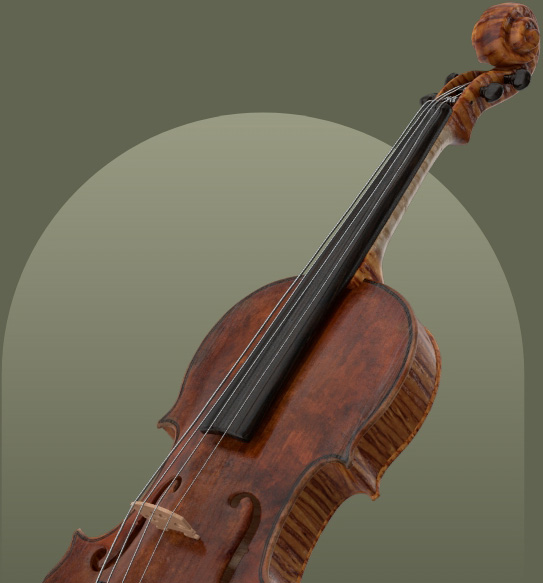
Matthias (II) Albani
Auction price history
Highest auction price
£38,580
| Type | Details | Sold | Price |
|---|---|---|---|
| Violin | Labelled Matthias Albanus me fecit. Bulsani in Tyroli. 1702 | October 2023 | £22,800 |
| Cello | 75.1 cm Bolzano, 1691 c. [Ascribed to] | October 2011 | £23,760 |
| Violin | 35.6 cm | June 2010 | £5,040 |
| Viola | 40.9 cm 18th C. [Attributed to] | April 2010 | £15,712 |
| Violin | 35.1 cm Tyrolean, 18th C. [Ascribed to] | April 2010 | £8,218 |
| Viola | 42.5 cm Austria, early 19th C. | October 2009 | £8,125 |
| Violin | 36.0 cm lion's head scroll [Attributed to] | June 2009 | £3,240 |
| Viola | 43.6 cm Austria, late 18th C. [Ascribed to] | March 2009 | £11,250 |
| Violin | 35.4 cm late 17th C. (later head) | March 2009 | £4,830 |
| Violin | 35.6 cm 1700 c. [Attributed to] | December 2008 | £9,083 |
| Violin | 35.3 cm Probably Tyrollean, early 18Th Century [Attributed to] | October 2008 | £1,404 |
| Violin | 35.4 cm Bulsano, 1700 c. | June 2008 | £7,706 |
| Violin | 35.4 cm Bolzano, 1680 c. | October 2007 | £22,911 |
| Violin | 35.0 cm Austria, 18th C. [Attributed to] | October 2007 | £5,625 |
| Violin | 35.5 cm [Ascribed to] | February 2007 | £1,061 |
| Violin | 36.0 cm Bolzano, 1690 c. | November 2006 | £38,580 |
| Violin | Bolzano, 1700 c. | March 2004 | £14,400 |
| Violin | 1692 | July 2003 | £8,400 |
| Cello | 1840 | December 2002 | £3,935 |
| Violin | 1702 | March 2001 | £7,800 |
| Violin | 1694 | July 2000 | £6,400 |
| Violin | 1694 | November 1999 | £4,830 |
| Violin | 1697 | March 1997 | £9,200 |
| Violin | 1710 c. | November 1993 | £20,700 |
| Violin | 1697 | March 1992 | £11,550 |
| Violin | 1700 c. | November 1991 | £4,840 |
| Violin | 1670 | November 1989 | £6,820 |
| Violin | 1705 c. | June 1988 | £15,400 |
| Violin | 1695 | June 1988 | £2,750 |
| Violin | 1718 c. | November 1987 | £12,100 |
| Violin | 1714 | March 1983 | £4,400 |
| Violin | 1694 | March 1981 | £1,538 |
Maker Overview
History
According to John Dilworth (The Brompton’s Book of Violin & Bow Makers), Matthias (II) Albani (1634-1712) was born in Caldaro (Kaltern) in 1634 and died in Bolzano, Italy, in 1712. Conversely, Cecie Stainer, in A Dictionary of Violin Makers, places his birth in Botzen (Bolzano) in 1650 and his death around 1715. He is presumed to be the son and pupil of Matthias Albani (I), though Dilworth notes the two are often conflated. Albani (II) underwent an apprenticeship with Martino Arz in Rome in 1664 and worked for Andrea Portoghesi in 1666. By 1671, he had established himself in Bolzano, where he was recorded as a violin maker. His earliest known work dates from about 1683. George Hart, in The Violin, observes that while his father was a German maker, Matthias (II) Albani's style is distinctly Italian, suggesting he is more appropriately classified as an Italian maker.
Craft
- Methods: John Dilworth describes Matthias (II) Albani's work as very cleanly finished. George Hart similarly states that his overall workmanship earned high praise.
Influence
- Training and Mentorship: Both John Dilworth and Cecie Stainer identify him as the presumed son and pupil of Matthias Albani (I). Hart observes he showed "faint marks of having been tutored by his parent." Stainer suggests he probably remained in Cremona, studying under the Amatis for some time on his way to Rome, while Hart states he is "said to have visited Cremona" for instruction under Amati. Dilworth mentions an authenticated label of J.E. Steger implying a pupil relationship with Matthias (II) Albani, but notes there is no known historical or stylistic link.
- Schools/Tradition: His influence extended beyond his immediate family to the Jais family in Bolzano and Mayr in Salzburg, as documented by Dilworth.
- Notable Associations: The famous violinist Tomaso Albinoni owned two of his violins, dated 1702 and 1709, according to Gerber as cited by Hart.
Legacy
- Famous Owners: The renowned violinist Tomaso Albinoni notably owned two of his violins, dated 1702 and 1709, a fact reported by Gerber and cited by Hart.
Further Information
- Technical Characteristics: According to Dilworth, his style is original and Italianate, possibly reflecting his early experience in Rome, and his instruments follow an Amatisé model, distinctly different from other Tyrolean work. Stainer confirms his instruments adhere to the Amati pattern. He used a rich red-brown varnish of excellent consistency, often with a deeply crackled texture, frequently mistaken for Venetian varnish. De Piccolellis reports a cello with a carved dragon’s head. Known labels include "Mattio Albano fece in Roma, 1684" (cited by Forino as anachronistic), "Mattio Alban fecit Bolzan, 1702," and "Mattio Alban fecit Bolzen, 1700" (cited by Lebet, Beare), as well as "Mathias Albanus, 1680," and "Mattia Albano, fec. in Roma, 16 - ."
- Historical Uncertainties: Sources present conflicting information regarding his biographical dates; Dilworth indicates birth in 1634 and death in 1712, while Stainer provides 1650 for birth and circa 1715 for death. Much of the work attributed to Matthias (II) Albani may actually be by his sons Michael and Joseph under his name, or inferior German copies of a later date, as noted by Dilworth. Hart also states he is often credited with the work of the elder Albani, due to a past supposition of only one maker of that name. Claims of his studying with the Amatis in Cremona are presented with some qualification, as evidenced by phrases like "probably remained" or "said to have visited."
Summary
Matthias (II) Albani (1634-1712), presumed son and pupil of Matthias Albani (I), was an Italianate violin maker primarily active in Bolzano, Italy. After an apprenticeship in Rome, he established himself as a violin maker around 1671. His work features cleanly finished instruments crafted on an Amatisé model, which distinctly set them apart from typical Tyrolean work, and are characterized by a rich, red-brown varnish often mistaken for Venetian. Despite historical disputes regarding his birth and death dates and uncertainties surrounding his training with the Amati family in Cremona, his craftsmanship consistently garnered high praise. His influence extended to other regional makers like the Jais family and Mayr, and his instruments were notably owned by figures such as the violinist Tomaso Albinoni. However, the attribution of some instruments to him remains uncertain, partly due to conflation with his father and potential contributions from his sons.
Biographies
John Dilworth
ALBANI, Matthias (II) Born 1634 Calduro (Kaltern), died 1712 Bolzano Italy. Presumed son and pupil of Matthias Albani (I), above, but usually conflated with him. Apprenticed to Martino Arz in Rome in 1664, worked for Andrea Portoghesi in 1666. Established in Bolzano c.1671, and recorded at that time as a violin maker. Earliest known work dates from c.1683. His style is very original and Italianate, possibly reflecting his early experience in Rome. Much of the work attributed to him seems either to be that of his sons Michael and Joseph under his name, or inferior German copies of later date. His influence goes beyond that of his immediate family to the Jais family in Bolzano, and Mayr in Salzburg. One authenticated label of J.E.Steger implies that he was a pupil of Matthias, but there is currently no known historical or stylistic link between the two makers. Matthias own work is very cleanly finished and on an Amatisé model, quite differentiated from other Tyrolean work. Rich red-brown varnish of excellent consistency, often with deeply crackled texture; frequently mistaken for Venetian. De Piccolellis reports a cello with carved dragon’s head. Forino cites a violin anachronistically labelled; Mattio Albano fece in Rome. 1684 More common forms; Mattio Alban fecit Bolzan. 1702 Mattio Alban. fecit Bolzen. 1700 [Lebet, Beare]
Sell your instrument with Amati
Get started by uploading photos of your instrument for our experts to review.
Sell your instrument with Amati
Get started by uploading photos of your instrument for our experts to review.