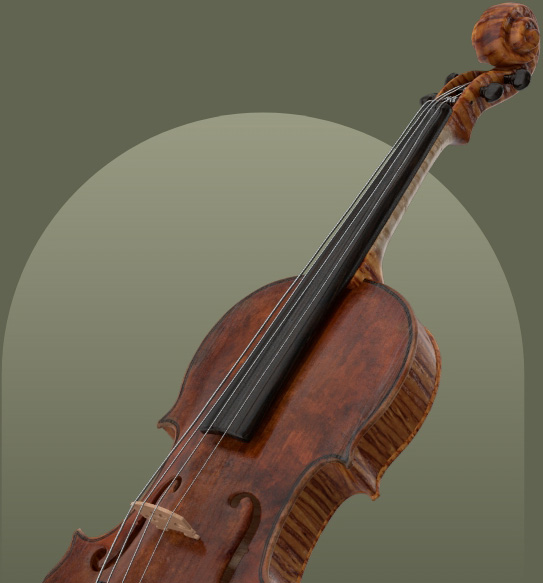
Matthias (I) Albani
Calduro, c.1621–1673
Matthias (I) Albani (circa 1621-1673) was a master luthier born in Calduro (Kaltern) and active in Bolzano, Italy. His authenticated work is rare and often described as being of the Stainer type, though his model also shows influence from the Amati school. There is historical debate, particularly noted by Willibald Leo Lütgendorff, as to whether there was one or two makers named Matthias Albani, with Lütgendorff favoring the existence of a single individual who evolved stylistically from Tyrolean to Italian influences. His instruments, characterized by high arching, careful workmanship, and a reddish-brown varnish, were highly regarded in the 18th century, leading to widespread circulation of false labels. He often preferred decorative heads over traditional scrolls and used various printed labels, frequently signing as Albanus or Alban.
Request an expert valuation or learn how our global auctions achieve the highest prices for your instruments.
Maker Overview
Life
Matthias (I) Albani (circa 1621-1673) was born around 1621 in Calduro (Kaltern) and died in 1673 in Bolzano, Italy. He is recorded as a master luthier in Bolzano, though authenticated work is exceedingly rare and challenging to identify, often described as being of the Stainer type in The Brompton's Book of Violin & Bow Makers. False labels dating from the 1640s are widely circulated, frequently found in lower-quality German trade instruments. Matthias (I) Albani is often conflated with Matthias Albani (II) in published works.
Willibald Leo Lütgendorff, in Die Geigen- und Lautenmacher vom Mittelalter bis zur Gegenwart, notes that the history of the Albani family remains largely unclarified. Given that violins bearing his name exist from as early as 1644 and as late as 1712, and show a complete stylistic change from 1680 onwards, it is often assumed there were two members of the family with the same name (father and son). Traditionally, the elder Matthias Albani was believed to be born in 1621 and died in 1673, and was considered a pupil of Stainer, while the younger was placed between 1650 and 1715 and declared an Amati pupil. However, Lütgendorff believes there was only one Matthias Albani. He suggests that Albani must have been roughly the same age as Stainer, making him more likely a fellow student. His earlier works are distinctly Tyrolean, but later pieces show an undeniable Italian influence. It is claimed that he traveled to Rome, and instruments dated from there are said to exist, though Lütgendorff, despite diligent research, has not encountered any of undoubted authenticity, only those without a place designation or explicitly stating Bolzano as the origin. While Lütgendorff does not know of genuine violins with authentic labels extending beyond 1706, he notes that some are said to exist from 1712. He posits that M. Albani, like Stradivari, could have remained capable of working past his ninetieth year, likely with the assistance of his son, Joseph, during his later period.
M. Fetis, quoting Moritz Berman's Biographical Dictionary, states that Albani was born in 1621 and died in 1673 in The Violin. Cecie Stainer, in A Dictionary of Violin Makers, also confirms his birth around 1621 in Botzen (Tyrol) and death there in 1673.
Characteristics
- Form and Arching
- His instruments are generally described as being of the Stainer type, but with a higher and heavier construction. Cecie Stainer notes they are much arched, with high sides. His model approaches the Amati school but is usually very highly arched with high ribs.
- Workmanship
- The work is very careful and meticulous.
- Wood Selection
- The top wood is particularly beautiful, while the back is usually plain maple wood. Cecie Stainer notes the wood is carefully selected.
- Varnish
- The varnish is described as very rich by George Hart. Lütgendorff characterizes it as reddish-brown, less elastic, and of Italian character. Cecie Stainer describes it as dry, brittle, and reddish-brown in color.
- F-holes and Scrolls
- The F-holes are often too widely opened. Instead of traditional scrolls, he preferred to incorporate heads, dragons, and grotesque figures.
- Violas
- For violas, he adhered to traditional forms, cutting soundholes in serpentine lines and adding a perforated round soundhole under the fingerboard.
- Artistic Development
- Like Stradivari, he only reached the peak of his art in the second half of his life. He is considered less original than Stainer but comes very close to him in tone.
- Tyrol.
fecit anno.16..John Dilworth
Influence and legacy
- Mentorship Debate: Sources contain conflicting information regarding his training. He was possibly a pupil of Stainer. However, Lütgendorff suggests that as he was roughly the same age as Stainer, he was more likely a fellow student rather than a pupil.
- Stylistic Evolution: His earlier works are distinctly Tyrolean, but his later work shows an undeniable Italian influence.
- Amati School: While Lütgendorff disputes the existence of two makers, the younger Matthias Albani was sometimes declared an Amati pupil, and the elder's model approaches the Amati school.
- Historical Reputation: In the 18th century, his violins were considered among the best known, alongside those of Amati and Stainer.
- Misuse of Name: Due to the high regard for his instruments, his name was frequently misused and applied to violins that bore no resemblance to his work.
- Exhibitions: A pocket violin made by him in 1680 was exhibited in South Kensington in 1872.
- Archival Research: Lütgendorff expresses hope that archival research will eventually clarify whether there was one or two masters named M. Albani.
Further Information
- Labels: He used various labels, almost always printed. Examples include "Matthias Albani in Bulsani. Tyrol. / fecit anno.16.." (Dilworth), "Mathias Albano, fecit in Tiroli, 1651" (Cecie Stainer), "Mathias Albano, in Tiroli, Bulsani, 1643" (Cecie Stainer), "Mathias Albani, fecit Bulsani, Tyrol, 1651" (Cecie Stainer), and "Matthias Albanus, fecit in Tyrol, Bulsani, 1654" (Cecie Stainer).
- Name Variations: He almost always signed his name as Albanus or simply Alban. The family name likely originates from the saint's name Alban and later adopted the Italian-sounding form Albani (Albano also appears).
Biographies
The overview above is drawn from the following published accounts. Read them in the original:
John Dilworth+
ALBANI, Matthias (I) Born circa. 1621 Calduro (Kaltern), died 1673 Bolzano Italy. Recorded in Bolzano as a master luthier, but authenticated work is extremely rare and difficult to discern; generally described as of the Stainer type. False labels from the 1640s are in wide circulation, mostly in poor German trade instruments. He is often conflated with Matthias Albani (II) in published works. Matthias Albani in Bulsani. Tyrol. / fecit anno.16..
Willibald Leo Lütgendorff+
Die Geschichte der Familie Albani ist noch vollkommen unaufgeklärt. Da es Geigen mit seinem Namen schon von 1644 und noch solche von 1712 giebt und diese Geigen von 1680 an einen vollkommenen Stilwechsel zeigen, so scheint es in der That nicht unberechtigt, wenn man zwei gleichnamige Mitglieder (Vater und Sohn) der Familie als die Verfertiger dieser Geigen annimmt. Bisher liess man den älteren Matth. Albani 1621 geboren und 1673 gestorben sein und machte ihn zu einem Schüler Stainer’s; den Jüngeren setzte man zwischen 1650 und 1715 an und erklärte ihn für einen Amati-Schüler. Trotz alledem glaube ich nur an einen Matthias Albani. Da er mit Stainer ziemlich gleichen Alters gewesen sein muss, dürfte er eher ein Mitschüler desselben gewesen sein. Seine älteren Arbeiten sind noch gut tyrolisch, später steht er unverkennbar unter italienischem Einfluss. Man behauptet, dass er auf der Wanderschaft bis Rom gekommen sei und dass von dort datirte Geigen vorhanden sein sollen. Mir ist trotz eifrigen Nachforschens eine solche von zweifelloser Echtheit bisher aber nicht vorgekommen, nur solche ohne Ortsbezeichnung oder mit der ausdrücklichen Angabe Bozens als Ursprungsort. Echte Geigen mit echten Zetteln, die über 1706 hinausgehen, kenne ich zwar nicht, doch soll es noch solche von 1712 geben. M. Albani kann eben so gut, wie Stradivari, bis über das neunzigste Lebensjahr arbeitsfähig geblieben sein und wird in der letzten Zeit wahrscheinlich an seinem Sohne Joseph einen für ihn arbeitenden Gehilfen gehabt haben. Seine Geigen galten im 18. Jahrhundert, neben denen von Amati und Stainer, als die besten, die man kannte; daher wurde sein Name auch vielfach missbraucht und in Geigen angebracht, die nicht einmal von ferne an seine Arbeit erinnern. Sein Modell nähert sich der Amati-Schule, ist aber meist sehr hoch gewölbt, mit hohen Zargen. Die Arbeit ist sehr sorgfältig. Das Deckenholz besonders schön, der Boden meist schlichtes Ahornholz, der röthlich-braune, wenig elastische Lack von italienischem Charakter. Die F-Löcher sind zu weit offen, statt der Schnecken liebt er Köpfchen, Drachen und Fratzen anzubringen. Bei den Violen bleibt er den hergebrachten Formen treu, schneidet Schalllöcher in Schlangenlinien und bringt unter dem Griffbrett noch ein durchbrochenes rundes Schallloch an. Eine Taschengeige von ihm aus dem Jahre 1680 war 1872 in South Kensington ausgestellt. Wie auch Stradivari erreichte er erst in seiner zweiten Lebenshälfte die Höhe seiner Kunst. Er ist minder originell als Stainer, kommt ihm im Ton aber sehr nahe. Hoffentlich wird sich die archivalische Forschung endlich auch einmal mit ihm beschäftigen und wenigstens die Frage lösen, ob es einen oder zwei Meister des Namens M. Albani gegeben habe. Er schreibt seinen Namen fast immer Albanus oder kurzweg Alban. Der Familienname geht daher wahrscheinlich auf den Heiligennamen Alban zurück und hat erst später die italienisch klingende Form Albani (auch Albano kommt vor) angenommen. Er gebrauchte verschiedene, fast immer gedruckte Zettel:
George Hart+
M. Fetis, quoting the Biographical Dictionary of Moritz Berman, with regard to Albani, states that he was born in 1621, and died in 1673. The form is somewhat like Stainer’s, but higher and heavier in construction. The varnish is very rich. Wood of good quality.
Cecie Stainer+
b. about 1621, Botzen (Tyrol); d. there 1673. His instruments are excellent, very similar to those made by Stainer, of whom he was possibly a pupil. They are much arched, with high sides, the sound-holes too widely opened, with dry brittle varnish, a reddish-brown colour, the wood is carefully selected. A violoncello, of sweet but not powerful tone, had the label in large characters: “ Mathias Albano, fecit in Tiroli, 1651.” A beautiful violin, with full, powerful tone, had the label in small characters: ” Mathias Albano, in Tiroli, Bulsani, 1643.” Two other labels are : ” Mathias Albani, fecit Bulsani, Tyrol, 1651,” and ” Matthias Albanus, fecit in Tyrol, Bulsani, 1654.”
Sell your instrument with Amati
Get started by uploading photos of your instrument for our experts to review.
Sell your instrument with Amati
Get started by uploading photos of your instrument for our experts to review.